Poor Charlie's Almanack: The Wit and Wisdom of Charles T. Munger, Expanded Third Edition English
"Poor Charlie's Almanack" is a classic. It's a compilation of speeches, writings, and interviews of Charles T. Munger, the longtime business partner of Warren Buffett and Vice Chairman of Berkshire Hathaway. Munger is renowned for his multidisciplinary approach to decision-making, and the book provides insights into his philosophy on business, investing, and life.
Book Summary:
- Multidisciplinary Thinking:
Munger advocates for the importance of adopting knowledge from various disciplines, and creating a mental toolkit that helps in making better decisions. He emphasises the need for a broad understanding of different subjects beyond one's primary expertise. - Inversion Principle:
Munger often uses inversion, a thinking technique that involves approaching a problem backwards, as a tool for solving complex issues. By considering the opposite of what you want, you gain a clearer perspective on potential pitfalls and solutions. - Circle of Competence:
Similar to Buffett, Munger stresses the significance of staying within one's "circle of competence." Understanding the limits of your knowledge and focusing on areas where you have expertise is crucial for successful decision-making. - Latticework of Mental Models:
Munger encourages building a latticework of mental models from various disciplines to solve problems and make decisions. This approach allows for a more comprehensive understanding of situations and facilitates better judgment. - The Psychology of Misjudgment:
Munger delves into human psychology and the common cognitive biases that can lead to poor decision-making. Recognizing these biases is vital for investors and decision-makers to avoid pitfalls and make more rational choices.
Lessons Learnt:
- Broaden Your Knowledge:
Constantly seek to expand your knowledge across different disciplines. Munger's approach involves integrating insights from various fields to gain a holistic understanding of complex issues. - Think Backward (Inversion):
Use inversion as a tool for problem-solving. By considering the opposite of your goals, you can identify potential obstacles and devise more effective strategies. - Know Your Limits:
Stay within your circle of competence. Understanding what you know and, more importantly, what you don't know is essential for making informed decisions. - Mental Models Matter:
Build a latticework of mental models. Having a diverse set of mental frameworks helps in approaching problems from different angles, leading to more robust decision-making. - Be Aware of Cognitive Biases:
Understand the psychological pitfalls that can lead to misjudgments. Being aware of common cognitive biases allows for more objective decision-making.
"Poor Charlie's Almanack" is a treasure trove of wisdom from one of the most respected minds in business and investing. We certainly enjoyed the read, we hope you do too.
Poor Charlie's Almanack: The Wit and Wisdom of Charles T. Munger, Expanded Third Edition English
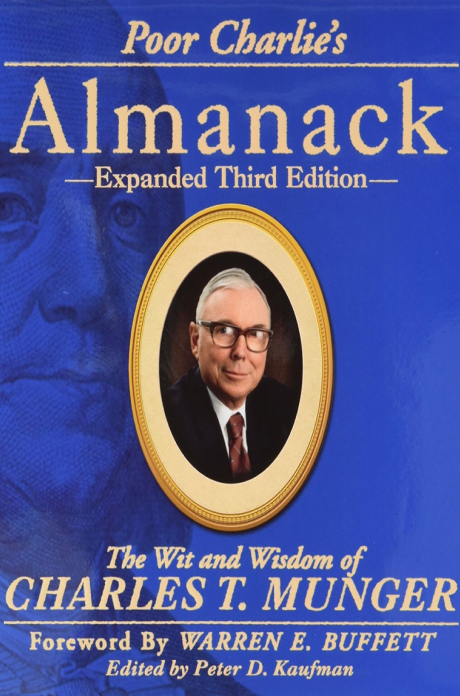
"Poor Charlie's Almanack" is a classic. It's a compilation of speeches, writings, and interviews of Charles T. Munger, the longtime business partner of Warren Buffett and Vice Chairman of Berkshire Hathaway. Munger is renowned for his multidisciplinary approach to decision-making, and the book provides insights into his philosophy on business, investing, and life.
Book Summary:
- Multidisciplinary Thinking:
Munger advocates for the importance of adopting knowledge from various disciplines, and creating a mental toolkit that helps in making better decisions. He emphasises the need for a broad understanding of different subjects beyond one's primary expertise. - Inversion Principle:
Munger often uses inversion, a thinking technique that involves approaching a problem backwards, as a tool for solving complex issues. By considering the opposite of what you want, you gain a clearer perspective on potential pitfalls and solutions. - Circle of Competence:
Similar to Buffett, Munger stresses the significance of staying within one's "circle of competence." Understanding the limits of your knowledge and focusing on areas where you have expertise is crucial for successful decision-making. - Latticework of Mental Models:
Munger encourages building a latticework of mental models from various disciplines to solve problems and make decisions. This approach allows for a more comprehensive understanding of situations and facilitates better judgment. - The Psychology of Misjudgment:
Munger delves into human psychology and the common cognitive biases that can lead to poor decision-making. Recognizing these biases is vital for investors and decision-makers to avoid pitfalls and make more rational choices.
Lessons Learnt:
- Broaden Your Knowledge:
Constantly seek to expand your knowledge across different disciplines. Munger's approach involves integrating insights from various fields to gain a holistic understanding of complex issues. - Think Backward (Inversion):
Use inversion as a tool for problem-solving. By considering the opposite of your goals, you can identify potential obstacles and devise more effective strategies. - Know Your Limits:
Stay within your circle of competence. Understanding what you know and, more importantly, what you don't know is essential for making informed decisions. - Mental Models Matter:
Build a latticework of mental models. Having a diverse set of mental frameworks helps in approaching problems from different angles, leading to more robust decision-making. - Be Aware of Cognitive Biases:
Understand the psychological pitfalls that can lead to misjudgments. Being aware of common cognitive biases allows for more objective decision-making.
"Poor Charlie's Almanack" is a treasure trove of wisdom from one of the most respected minds in business and investing. We certainly enjoyed the read, we hope you do too.
Categories